
2026’s New Food Pyramid: Real Food, Real Results 🥩🥬
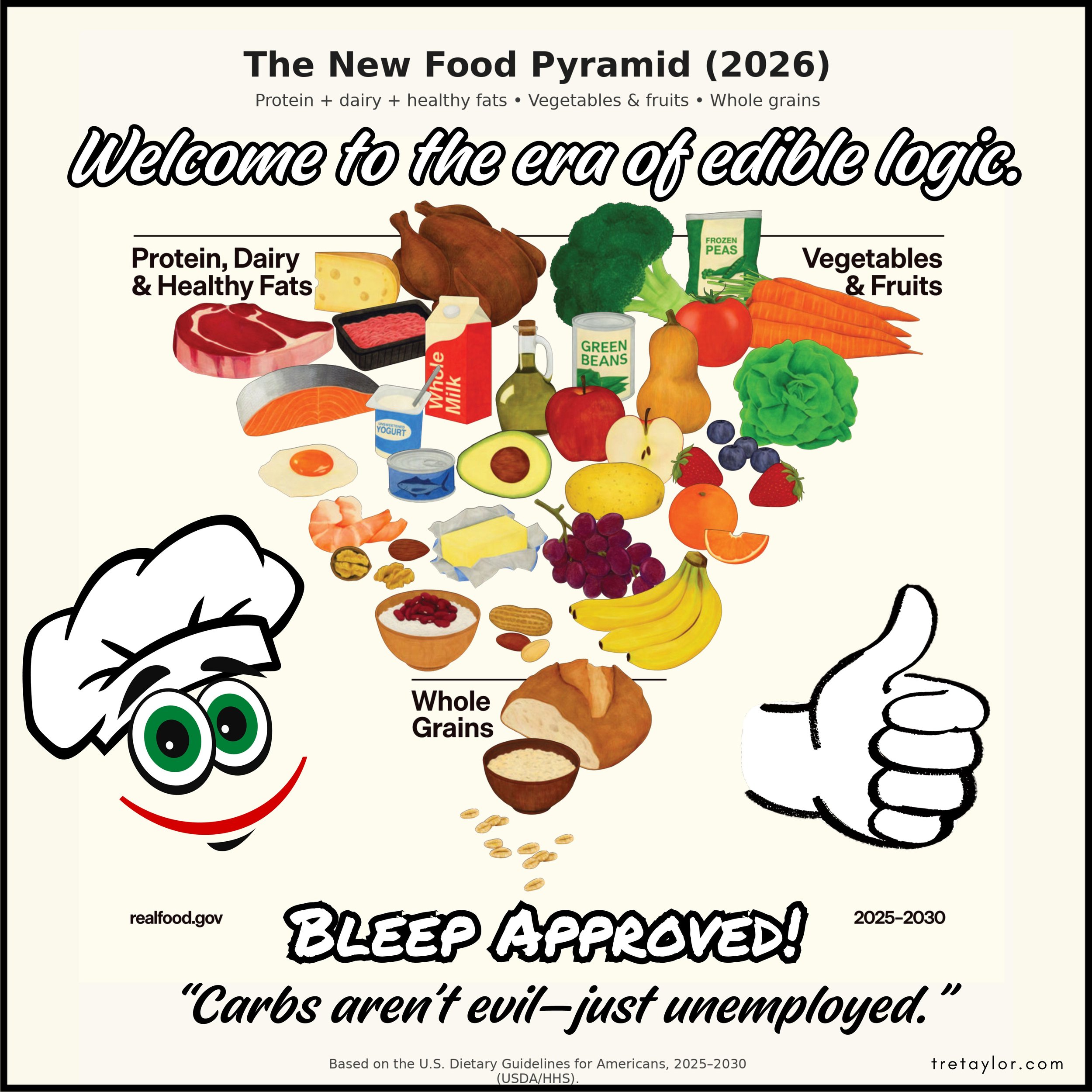
The brand-new 2026 U.S. Food Pyramid is here, and it’s flipping old nutrition myths on their glittery heads. In this easy, down-to-earth guide, Tré Taylor and Bleep the Tattoo (tiny chef hat, huge opinions, minor swearing problem) break down why the pyramid was updated, what it recommends now, and how this “real food” shift can support better energy, fewer cravings, and simpler meal choices—especially for a January reset. We’ll share the big benefits, a few smart cautions, and recipe inspiration to help you build healthier, happier, more delicious meals you’ll actually want to eat. Bleep Approved. ✅👨🍳
Written by Tré Taylor and Bleep the tattoo
Category: Health & Wellness—Update: Brand new U.S. Food Pyramid (2026)—released today, January 7, 2026.
“Bread’s demoted. Nobody panic.”
Here’s what we know, why it changed, and why it’s exciting.
If you’re around 25, you might only remember the nutrition “rules” as a chaotic TikTok tug-of-war:
“Carbs are evil.”
“No, carbs are life.”
“Fat is bad.”
“Wait… fat is fine?”
“Help, I ate a bagel, and now I’m in a moral crisis.”
Good news: the new U.S. guidance is basically saying, "Calm down and eat real food." And honestly? That’s a pretty solid direction for the future.
This update comes with a new, inverted food pyramid that puts the focus on:
Protein + dairy + healthy fats (top priority)
Vegetables and fruits
Whole grains (still included, just not the foundation of everything)
And the big “villain” is no longer “fat” or “carbs” in general. The villain is highly processed food—especially the salty/sweet, refined-carb, ready-to-eat stuff that keeps people hungry and tired.
Why did they update it?
Because the old approach didn’t match what’s happening in modern health.
1) Chronic disease is everywhere, and diet is a major lever
The new guidelines are trying to be more direct: we can’t keep building daily eating around ultra-processed convenience foods and expect our bodies to thrive long-term.
2) They’re returning to “food you can recognize.”
The “real food” framing is basically a reset toward what your great-grandma would understand as food:
meat, eggs, fish, beans
vegetables, fruit
plain dairy
nuts, seeds, olives, avocado
whole grains in actual forms (think oats/rice/real sourdough), not “edible snack engineering”
3) They want the guidance to be usable in real life
A lot of past nutrition advice got buried in details. This update is trying to give people a simple framework—something you can apply while standing in the grocery aisle, not only in a graduate seminar.
What’s exciting about the new pyramid (the big benefits)
✅ Benefit #1: It supports stable energy and fewer cravings
When meals start with protein + produce + healthy fat, people tend to feel fuller longer. Translation: fewer “I’m starving again” moments two hours later.
✅ Benefit #2: It’s better for muscle and metabolism (especially as we age)
The guidance raises protein targets higher than many people are used to hearing. That’s a big deal because muscle is protective: for strength, mobility, blood sugar stability, and overall resilience.
✅ Benefit #3: It encourages a “crowding out” strategy instead of shame
Instead of “Never eat X again,” it’s more like:
“Eat enough real food that the fake stuff stops running your life.”
That’s how habits actually change without turning into punishment.
✅ Benefit #4: It’s a recipe goldmine
This pyramid isn’t a “diet.” It’s a meal-building formula:
choose a protein
add vegetables (or fruit)
add healthy fat
include whole grains as needed (not as a default base for every meal)
That’s flexible, sustainable, and future-friendly.
Bread lovers: let’s talk 🍞 (because yes, it’s January, just in time for your New Year’s diet).
If you’re “addicted to bread,” you’re not broken. Bread is:
cheap
comforting
fast
culturally important
emotionally supportive (sometimes more supportive than people, honestly)
But the pyramid putting grains at the bottom is basically saying:
“Grains can be part of the plan… but they shouldn’t be the main character.”
What to do if bread is your comfort food:
Don’t quit bread in a dramatic breakup text. Start with portion and quality.
Trade “refined and fluffy” for whole/traditional when you can: oats, brown rice, true sourdough, and less-processed tortillas.
Pair bread with protein and fat so it doesn’t spike your hunger later.
Example: toast + eggs + avocado beats toast alone every time.
Real talk: if bread is your only safe food right now, start where you are. Add protein and veggies around it first. That’s still progress.
BLEEP : “They put bread at the bottom. I’m not mad… I’m just in carbs denial.”
What the new pyramid is basically telling you to do
Build meals like this:
Protein: eggs, fish, chicken, beef, yogurt, cottage cheese, tofu, beans/lentils
Vegetables & fruit: aim for color and variety
Healthy fats: olive oil, avocado, nuts/seeds, eggs, naturally fatty fish, etc.
Whole grains: keep them “real,” and don’t let refined carbs crowd out the good stuff
Processed foods and added sugar: treat like an occasional guest, not a roommate
BLEEP: “If you see me wrestling a loaf of bread in the parking lot—no, you didn’t.”
Anything to be cautious about?
Even if this is a strong step, a few wise cautions keep this new change credible:
“Highly processed” can be a fuzzy category
People will argue about what counts. Expect confusion and strong opinions.More protein isn’t one-size-fits-all
If someone has kidney disease or specific medical issues, they should talk with a clinician before pushing high protein targets.Don’t let “perfect” kill “better.”
If someone goes from chips for dinner to eggs + veggies + fruit, that’s a win—even if they still eat bread.
BLEEP: “I support this pyramid. But I’d like to submit a proposal for a tiny dessert triangle once a week.”
Three belief-changing questions to end the old food-pyramid mindset
“Does this meal keep me full and steady… or does it make me hungry again fast?”
“How close is this food to its original form in nature?”
“If I ate this way most days, would my body thank me—or complain loudly?”
I’m going to keep building recipes around this new framework—simple, satisfying, and realistic. If you’re doing a January reset, I’m cheering for you. Let’s make ‘healthy’ feel like real life again.
I hope this helped you and the ones you love. And I hope to make easier, healthier, happier, and fun recipes built around this new guideline.
With love, music, food (better food, that is), art, and fun,
Tré Taylor & Bleep the Tattoo 🐾🎶🥗✨
References:
1) Dietary Guidelines for Americans, 2025–2030 (PDF)
https://cdn.realfood.gov/DGA.pdf
2) RealFood.gov “The New Pyramid” + FAQs + downloads
3) USDA press release (Jan 7, 2026): “Historic Reset… Put Real Food Back at Center of Health”
4) HHS fact sheet (Jan 7, 2026): “Resets U.S. Nutrition Policy…”
https://www.hhs.gov/press-room/fact-sheet-historic-reset-federal-nutrition-policy.html
5) DietaryGuidelines.gov: Scientific Report of the 2025 Dietary Guidelines Advisory Committee (landing page)
https://www.dietaryguidelines.gov/2025-advisory-committee-report
6) DGAC Scientific Report PDF (Dec 2024)
7) MyPlate.gov: “What happened to the Food Guide Pyramid?”
https://www.myplate.gov/eat-healthy/what-is-myplate
8) USDA Food & Nutrition Service: MyPlate background (“replaced… in June 2011 ”)
https://www.fns.usda.gov/cnpp/myplate
9) AP News coverage (Jan 7, 2026) summarizing key changes and context
10) FDA page on Ultra-Processed Foods (definition work + context)
https://www.fda.gov/food/nutrition-food-labeling-and-critical-foods/ultra-processed-foods
