
🧬 Energetic Boundaries for Neurodiverse Intuition 🧿
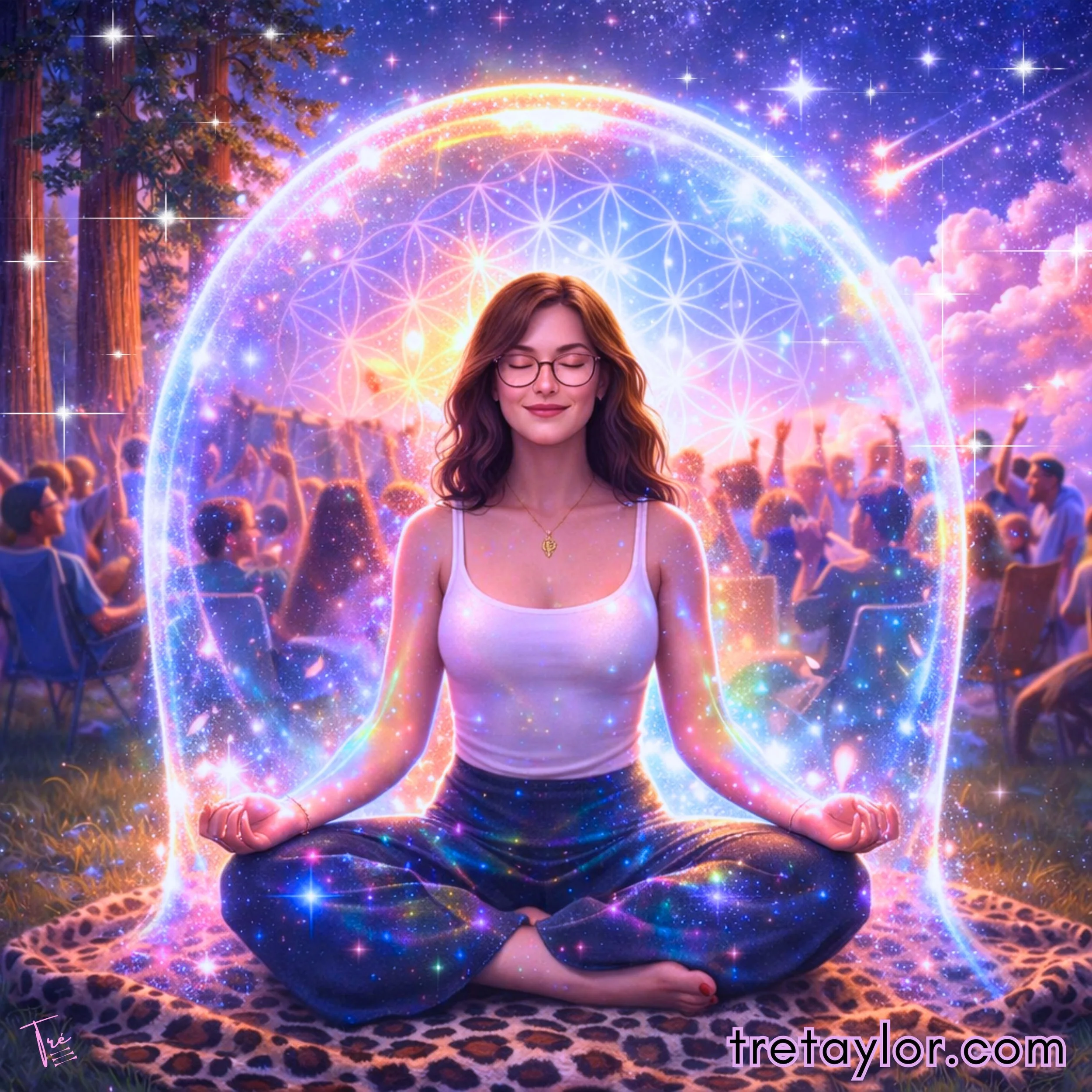
Empaths and neurodiverse sensitives often feel overwhelmed by crowds, conflict, and emotional noise. This empowering, funny, compassionate post offers validation, energetic boundary tools, and a simple visualization practice to help you stay open-hearted without absorbing everyone else—plus insight into “weight as insulation” and nervous-system safety for psychic, clairsentient, and highly sensitive people. www.tretaylor.com
Written by Tré Taylor & Bleep the Tattoo
Category: Health & Wellness • energetic boundaries • neurodiversity • psychic safety • self-mastery
🎆 Happy New Year, sacred weirdos.
If you’re an empath—or clairvoyant, clairsentient, kinesthetic-sensitive, autistic, ADHD, neurospicy, spiritually tuned, or just the kind of person who can feel a stranger’s heartbreak from three aisles away at the grocery store—come closer.
Because I need you to hear this plainly:
✅ You’re not weak.
✅ You’re not “too much.”
✅ You’re not crazy.
✅ You’re not failing at life.
You’re sensitive in a world that rewards numbness and calls it “strength.”
And yes—sometimes that makes basic things feel weirdly hard.
🌀🧠 “If you know, you know” (what empathy overload actually feels like)
Some days it’s not “anxiety.” It’s overload.
A loud restaurant can feel like your nervous system is being shaken like a soda can
Crowds can feel like 400 radio stations playing at once
One passive-aggressive comment can loop in your head for three days like it’s the season finale
Family gatherings can feel like the Trigger Olympics
You absorb emotions that aren’t yours… then blame yourself for having them
And the worst part?
You might look “fine” on the outside while the inside of you is doing advanced calculus just to stay socially functional.
Bleep: Empaths don’t have anxiety… we have emotional Wi-Fi. And it keeps auto-connecting to everybody’s nonsense.
🧿❤️ Validation for the psychic empaths (especially the ones carrying extra weight)
I want to say this with tenderness and zero judgment:
If you’re psychic, empathic, or clairsentient—if your body is basically a truth detector—and you’re also very overweight, I see you.
I was you.
And for me, part of the weight wasn’t just food or hormones or stress (though those matter too). Part of it felt like insulation. I lost 175 pounds and have kept it off for over 10 years now.
I know what it’s like. It was like my body was trying to create a buffer between my sensitivity and the world.
Because when you feel everything, your system starts asking:
“How do I protect us?”
And sometimes the answer your body chooses is more layers.
So if you’re 200 pounds overweight and you’ve been shaming yourself, blaming yourself, or feeling like you’re “undisciplined”…
I’m not here to coddle you, but I am here to tell the truth:
It makes sense.
Your body may have been doing its best to keep you safe.
And when I began losing weight—slowly, imperfectly, honestly—what surprised me wasn’t just the physical change.
It was this:
as I started honoring myself, accepting myself, and loving my weirdness, the insulation started to melt.
Not because I became someone else.
Because I stopped treating myself like a problem to be fixed.
🛡️🌿 The truth nobody wants to say out loud (but we’re saying it)
Just because you’re sensitive doesn’t mean the world has to reorganize itself around you.
The room does not owe you silence.
The grocery store does not owe you peace.
Your family does not owe you emotional maturity. (I know. Tragic.)
But here’s the other truth that matters just as much:
You owe yourself respect.
That’s what energetic boundaries are: self-respect in action.
Not spikes. Not walls. Not “I hate people now.”
A container. A structure. A choice.
🧭🔥 “Toughen up” without closing your heart
Let’s redefine “toughen up.”
Toughen up doesn’t mean turning cold.
It means turning clear.
A healthy boundary sounds like:
“I can feel you… and I don’t have to carry you.”
“I can love you… and still say no.”
“I can sense the vibe… and leave before it eats my nervous system.”
That’s not selfish. That’s self-leadership.
And self-leadership is what keeps an empath from becoming a hermit who flinches at notifications.
Bleep: “Toughen up” doesn’t mean “become a jerk.” It means “stop volunteering as the emotional sponge for strangers.”
🕯️⏳ Why it gets easier with age (especially midlife and beyond)
This part is for the younger empaths and the midlife empaths who feel behind.
It gets easier because sensitivity becomes skill.
Over time—if you practice—you learn:
what’s yours and what isn’t
when to engage and when to exit
when your intuition is guidance vs. old fear
how to stay kind without becoming the emotional sponge of the room
You don’t become less sensitive.
You become less scattered by what you sense.
That’s self-mastery. And it’s real.
🎭🎤 Sensitivity as a superpower (especially for performers)
If you’re a performer, musician, artist, healer, coach, parent, or someone who truly listens and Can Hear—sensitivity can be a gift.
You can read a room.
You can feel what people need.
You can sense subtle shifts before they become explosions.
But sensitivity only stays power when it’s regulated.
Otherwise it becomes overwhelm, overgiving, people-pleasing, and emotional hangovers that take three business days to recover from.
So the goal isn’t less sensitivity.
The goal is more regulation.
🫧🧘 A Visualization Practice: “Give Yourself More Room”
This is one of my favorite tools because it’s practical and quiet and you can do it anywhere.
If you’re in a class, store, restaurant, waiting room, gathering—anywhere overload starts rising:
🌬️ 1) Pause and breathe
One deep breath. If you can close your eyes, great. If not, soften your gaze and do it internally.
🫀 2) Feel your body. Feel your energy
Bring your attention into your chest, belly, legs. Feel you.
Not your thoughts about you—you.
🌟 3) Expand gently
Imagine you can push your energy a little bigger—not like armor. Like space.
You’re giving yourself more internal room for:
your emotions
your thoughts
your sensory experience
your breath
A private inner space big enough to exist without panic.
🪞 4) Optional: the “Teflon mirror coat”
If you’re around intense personalities, power struggles, manipulation, or people who treat your sensitivity like a buffet…
Imagine the outside of your energy field has a mirrored, Teflon-like coating.
What isn’t yours doesn’t stick.
“I can witness you… without absorbing you.”
☁️ 5) Practice non-judgment (it reduces energetic friction)
Okay—non-judgment sounds simple, like one of those quotes you’d put on a mug, but in real life it’s advanced spiritual calculus… because it requires something wild: accepting yourself first. And for neurodiverse people, that can be hard, because you’re going to make more mistakes than most people—and if you don’t learn how to hold that with tenderness, you’ll turn your sensitivity into self-attack.
Here’s the truth: self-preservation is a sacred duty. Caring for yourself gently isn’t indulgent—it’s how you keep your nervous system from living in a constant court trial. And yes, you still have to take accountability. Accountability is what frees you from learned helplessness, the “what’s the point” fog that can come with neurodiversity—especially for late-diagnosed Gen X women like me who had to survive without the right names, tools, or support.
We became the wounded healers. The phoenixes. I wear black because it’s a reminder of what has burned a way - the black soot of everything that has burned away—everything that no longer belongs on my body, in my world, or in my energy. I’m in my fire goddess era, and I’m starting over… but I also feel new, like I switched timelines, and time itself is speeding up.
So this practice isn’t just for psychics and highly sensitive people—it’s for anyone who wants self-mastery. Because if you can regulate and focus, you can build the life you want. You can close the sale. You can be extraordinary at what you do—especially if you’re intuitive and you believe in what you’re offering. And here’s the sneaky magic: when you stop secretly judging people, your nervous system gets quieter. You become less angry. Less hooked.
You start forgiving people for being human—without excusing bad behavior. Non-judgment doesn’t mean “approve.” It means “I’m not letting my energy chain itself to this.” You can hold a neutral boundary. You can see ego, envy, competition, darkness, weirdness—and choose not to attach. That’s energetic hygiene. That’s peace. And it changes everything.🧘♀️
🌙 6) Return to your breath. Return to you
This is practice. It gets easier with repetition.
And as you get better, you become safer—inside your own skin and outside it.
This can also help protect you from people who don’t have empathy, don’t have self-reflection, and feed on chaos—narcissistic dynamics, sociopathic behavior, emotional predators, and anyone who can’t—or won’t—see you clearly.
🧠✨ 7) Why this practice works (a more science-forward explanation)
If you’re not spiritual—or you’re spiritual but you also want receipts—here’s the science-ish, nervous-system-friendly version of why “visualizing an aura” can actually help.
Your brain and body don’t run only on conscious logic. They run on prediction. Your nervous system is constantly scanning for cues and deciding, Am I safe? Am I threatened? Do I need to mobilize? For highly sensitive and neurodiverse people, that scanner is often turned up loud. You pick up more signals, you process more input, and your body can flip into overload before your rational mind has even finished the sentence.
This is where visualization stops being “pretend” and starts being training.
When you do the “give yourself more room” practice, you’re using a few real psychological mechanisms:
• Mental rehearsal (imagery training):
Athletes rehearse a movement in their mind to improve performance. Your nervous system doesn’t fully separate imagined experience from real experience—especially when the imagery is emotionally vivid. So when you rehearse calm + containment, you’re building a familiar pathway your body can access in a stressful moment.
• Attention as a regulator:
Where attention goes, your nervous system follows. When you bring attention back to breath and body, you’re strengthening interoception (your ability to sense internal state) and reducing the “external hijack” that happens when you’re flooded by other people’s moods, tone, or chaos.
• Conditioning a new response:
If your default pattern is “absorb → spiral → overthink → collapse,” this practice interrupts the chain and replaces it with “notice → contain → return.” Repetition matters. It’s not one perfect session—it’s building a reflex.
• Placebo (aka: the mind-body frontier we still don’t fully understand):
Placebo isn’t “fake.” It’s meaning + expectation + context changing biology. We know beliefs and expectations can alter symptoms like pain, stress responses, and even measurable physiological outcomes in some settings. The mystery is how powerful it can be. But the point for you is this: if the brain can shift the body because it believes something supportive is happening, then a self-directed ritual—done with sincerity—can become a way of signaling safety to your system. It’s you saying: “We’re not helpless. We have a method. We have a plan.”
And this is where it gets really interesting—because you don’t just want to feel calm. You want to change what you believe is possible. A lot of overwhelm isn’t only sensory; it’s also limiting beliefs running in the background:
“I can’t handle this.”
“I’ll mess it up.”
“I’m too much.”
“Nothing works for me.”
Those beliefs once protected you. They helped you anticipate disappointment. They helped you survive. But they also shrink your world.
So when you practice this, you’re standing on the precipice of the present moment—the decision point—and you’re training a new internal message:
I deserve to feel safe.
I can receive support.
I can create space inside myself.
I can witness without absorbing.
That sounds simple, but it’s actually nervous-system rewiring. It’s self-mastery in motion.
And you won’t always know you’re improving until you test it in real life—classrooms, concerts, crowded stores, around intense coworkers, around family dynamics. Sometimes you’ll do amazing. Sometimes it’ll be a disaster. That’s not failure—that’s data. That’s training.
Over time, this practice builds the muscle that changes everything: response flexibility. That’s the ability to pause, choose, and act from your values instead of your triggers. And when you have that, you become harder to manipulate, harder to derail, and much more capable of creating the health, wealth, love, and peace you want—because you’re no longer fighting yourself while trying to live your life.
Bleep: It’s basically “brain and nervous system training,” but with sparkles. And frankly, science could use more sparkles.
📝 Gentle journal prompts (optional, not homework… okay, tiny homework)
Where do I consistently get overwhelmed—and what is that situation asking me to change or protect?
What does my body do when I’m absorbing other people—and what would it feel like to choose “not mine”?
If I treated my sensitivity like a gift I’m responsible for, what boundary would I practice this week?
And before I go, let me say this from my heart: I’m a work in progress. I’m not writing this from the top of a mountain with perfect boundaries and a halo that never slips. I’m writing this as someone who has had to find workarounds that actually work in real life—because that’s how I survived.
My body doesn’t respond well to medication, and there’s no surgery for “feeling everything.” There’s no magic switch. There’s just what you can practice, what you can repeat, and what you can gently refine—one grocery store trip, one awkward class, and one too-loud room at a time. And the honest truth? Sometimes you don’t even know if you’re getting better until you put yourself in an uncomfortable situation and test it… and sometimes it’s a disaster. That doesn’t mean you failed. It means you’re learning.
If there are people out there like me—trying to stay open-hearted in a world that can be sharp—I hope these little tips bring you real relief. You matter. You came into this life with unique abilities that can feel like a curse in the wrong environment… But with the right mentorship, guidance, and practice, they can also protect you. They can save you heartache, financial loss, and worse: a lifetime of sadness and isolation. So please don’t give up on yourself. Keep going—softly, steadily, and with love.
Bleep: And if today was a mess? Congratulations. You’re officially in the “learning in public” program. No refunds. 🖤
With love, music, food, art, and fun,
Tré Taylor & Bleep the Tattoo
🎆 Happy New Year, sacred weirdos.
