
🌙 The Strange Gift of Solitude
Solitude starts as relief—then it becomes a mirror. In this Confessions entry, Tré Taylor shares how grief, neurodiversity, and van life stripped away the mask and helped her come back to herself. Skeptic or mystic, you’ll find practical tools, honest truth, and a little humor that makes the hard stuff easier to hold.
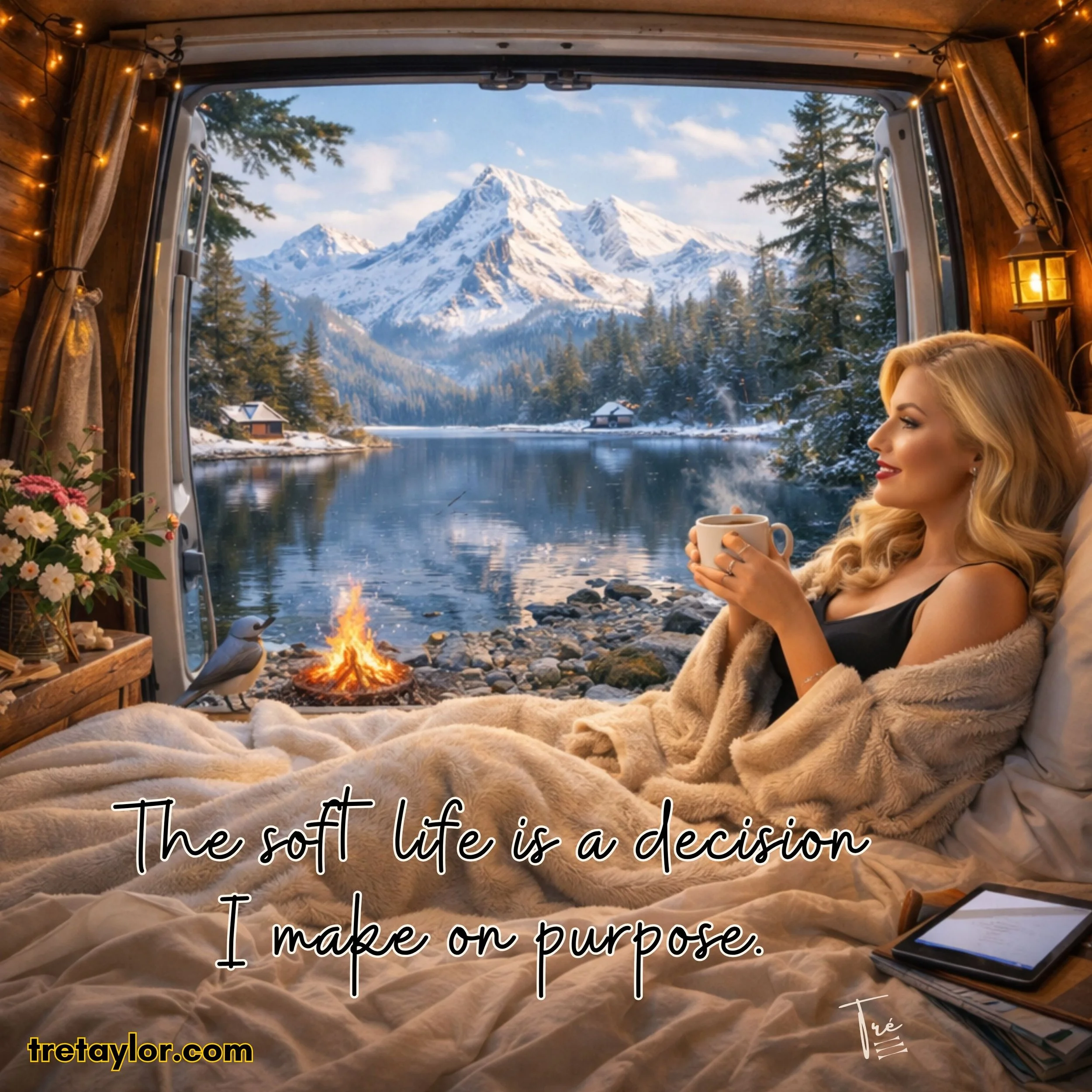
“Home Is Where You Park It”is an atmospheric techno-trance track created as the musical companion to my blog post “The Strange Gift of Solitude.” With ethereal vocals, a warm bass pulse, and subtle tribal textures, it’s part lullaby, part deep groove—made for anyone who needs a quiet reset. The song captures the feeling of van doors open to a glassy lake, coffee in hand, and the simple truth that solitude can be sovereignty: a soft-life choice you make on purpose. www.tretaylor.com
Written by Tré Taylor & Bleep the Tattoo
Category: Confessions…
🔎 Quick Highlights (for the skimmers, the tired, and the secretly curious)
🧠 How solitude removes the mask—and what shows up underneath
🌧️ Grief, overwhelm, and the nervous system’s need for quiet
🎭 Neurodiversity, “passing,” and the question: what’s real vs. adaptation?
🚐 Van life as a portable sanctuary: safety, order, and self-trust
🎶 Why improvisation (especially jazz) is a survival skill—and a superpower
🧭 A skeptic-friendly way to talk about intuition, meaning, and “guidance”
🐣 A hint of what’s next: characters, music, and a new creative quest
Bleep says: “If you’re only here for the highlights, welcome. If you’re here for a spiritual awakening, please wipe your feet.”
There’s a kind of quiet that feels like relief at first.
Not the peaceful, spa-music quiet. I mean the post-overwhelm quiet—the moment your nervous system finally stops bracing for impact. The moment you realize nobody is about to demand something, judge something, misunderstand something, or drain your last teaspoon of energy like it’s a free sample at Costco.
Solitude can feel like an exhale.
And then—if you stay there long enough—it becomes something else.
It becomes a mirror.
At first, I thought solitude was just recovery. I was tired of people. Tired of noise. Tired of social performance. Tired of trying to be “normal” in a world that rewards sameness and punishes nuance.
But the longer I lived quiet, the more I started noticing something strange:
Solitude doesn’t just remove other people.
It removes your mask.
And once the mask is off, you start meeting parts of yourself you didn’t even know were missing.
⚡ The side effect nobody warns you about
Here’s the side effect of being alone long enough:
You start hearing your own voice again.
Not your polite voice. Not your “I’m fine” voice. Not your “please don’t leave” voice.
Your real voice.
For me, that voice arrived with grief in one hand and freedom in the other.
I’ve had a lot of sudden death around me—more than feels fair. I wasn’t “from the streets” or living some chaotic lifestyle. It was just… my timeline. War trauma rippling through families. People not coming back the same. People not coming back at all. Men coming home from Vietnam shattered. My father carried the scars of the Korean War—creative, capable, emotionally unreachable, and complicated as hell.
And when you grow up around unprocessed trauma, you learn early that the world can turn on a dime. So you become hyper-aware. You become a reader of rooms. A translator of moods. A survival artist.
You become—without choosing it—someone who is always tracking safety.
Solitude is the first time the tracking system gets to rest.
But here’s the twist: when the tracking stops, what rises up is everything you postponed.
Grief. Rage. Longing. Exhaustion. The ache of not being seen. The question you were too busy surviving to ask:
Who am I when I’m not adapting to everybody else?
Bleep says: “Translation: you stopped running… and your feelings caught up like ‘SURPRISE, BESTIE.’”
🌿 If you’re “too much,” solitude will teach you something holy
I used to think I was “too much” for people.
Too sensitive. Too intense. Too happy. Too direct. Too pretty. Too weird. Too loud. Too soft. Too deep. Too cheerful. Too intuitive. Too something.
And when people can’t categorize you fast enough, some of them get uncomfortable.
That’s not a judgment. It’s just mechanics.
A lot of humans find comfort in predictability. And I’m… not predictable. I’m a mystic with a clown brain. I’m the kind of person who can cry over a song, then make a joke that would get me politely escorted out of a yoga retreat.
I used to take other people’s reactions personally. Now I’m starting to see it differently:
If you trigger someone just by being alive in your own frequency, that’s not necessarily about you. Sometimes you’re just standing too close to a wound they haven’t looked at yet.
Solitude helped me stop trying to manage that.
Bleep says: “If your joy annoys them, congratulations—you found their unpaid emotional bill.”
🧪 A skeptic-friendly note about the “mystical stuff”
I’m going to say something upfront, because it matters.
I’m not asking you to believe my cosmology.
I’m not asking you to adopt my language about dimensions, guides, “love teams,” or the Monad (that’s the word I use for the original unified consciousness—the “One” behind everything).
I’m asking something simpler:
Notice the pattern. See if it helps you live.
If you’re spiritual, you’ll recognize this as guidance.
If you’re scientific, you might recognize this as pattern recognition, intuition, nervous system regulation, and meaning-making.
Different maps. Same mountain.
Bleep says: “Believe whatever you want. Just don’t weaponize it. That’s my religion.”
🧠 What solitude showed me about my brain
Two years ago, I learned something that changed my life: I have narrative reasoning dyslexia.
It’s like my brain is designed to think in story, soundtrack, image, emotion, metaphor, pattern.
Which explains… a lot.
It explains why I can write lyrics in my sleep, but numbers can feel like they’re doing parkour across the page.
It explains why I can improvise on stage with world-class jazz musicians—no rehearsal, just trust and timing—yet struggle with basic “normal life” tasks that seem effortless for other people.
It explains why I’ve lived most of my life feeling like I was failing at the wrong game.
And it explains why AI hit my life like rain in a drought.
Not because I’m trying to replace being human—because I’m trying to translate being human.
AI didn’t give me a new personality. It gave me a tool that can hold my thoughts long enough for me to shape them. It’s like having a patient assistant who doesn’t shame me for how my brain works.
That alone is a miracle.
Bleep says: “AI didn’t make her smarter. It made the world stop yelling in spreadsheet.”
🚐 The van: my portable sanctuary
I live in a van, and yes—sometimes it’s lonely.
But it’s also been one of the most healing environments I’ve ever had, because it gave me something trauma survivors desperately need:
control over my space.
When your nervous system has lived in threat for a long time, order is not about aesthetics. It’s about safety.
And I’m germaphobic—not in a cute, quirky way. In a “my nervous system relaxes when my space is clean” way.
The van became my chrysalis: small, controllable, tidy, mine.
Not a forever-home. A healing room on wheels.
And in that small space, something big happened:
I started meeting the version of myself that isn’t masking.
🎭 The mask question that haunts neurodiverse people
Here’s a question I’ve been sitting with:
What part of me is real, and what part is adaptation?
If you’ve spent your whole life trying to pass as “normal,” you learn to perform competence. You learn to perform calm. You learn to perform “I’m fine.”
And then one day you get quiet long enough to realize:
You’ve been so good at survival that you don’t know where survival ends and you begin.
Solitude doesn’t answer that question quickly.
But it gives you the space to ask it without being interrupted.
Bleep says: “If you don’t know who you are, that’s okay. Start with who you are when nobody’s watching.”
🎶 Why jazz saved me (and why it matters here)
I’m a performer. A vocalist. A storyteller. An improviser.
I’ve been blessed to work with incredible Bay Area jazz musicians—players who can read you in half a bar and lift you with a single chord change. We don’t rehearse. We wing it. That’s jazz. That’s trust.
And here’s what I’ve learned:
Improvisation is a neurodiverse superpower.
Not because we’re “better.” Because we’ve had to adapt in real time our whole lives.
When you’ve been decoding the world since childhood—reading moods, scanning safety, translating yourself—you get good at in-the-moment creativity.
Jazz didn’t just give me music. It gave me a place where my brain made sense.
And the more I sit in solitude, the more I realize: I’m not broken. I’m specialized.
Bleep says: “She doesn’t rehearse. She survives in swing time.”
🫶 What my “love team” feels like
I call it my “love team” because “God” feels too small of a word for what I experience.
For me, it’s like having a very personal relationship with something vast—something intelligent, affectionate, occasionally hilarious, and oddly practical.
It doesn’t always feel like thunder and prophecy.
Sometimes it feels like:
a sudden calm
a clear “don’t do that”
an unexpected opportunity
a song lyric that drops in like a gift
a character showing up in my imagination like they’ve been waiting backstage
And yes—sometimes it feels like hints in a game.
Like: “Warm. Warmer. Not that door. That one.”
If you prefer a non-mystical translation, here it is:
Sometimes when you get quiet enough, your unconscious mind can finally speak in full sentences.
Bleep says: “Your intuition is not ‘woo.’ It’s your brain finally getting a mic.”
📚 What this series is going to be
This is the first post in a series about what I’m learning on the other side of burnout, grief, neurodiversity, and survival.
I’m going to share:
what solitude taught me
how I started setting better boundaries (energetic and practical)
how I use timing tools like astrology as a map for your 3D lifetime current avatar
how creativity became healing technology
how I’m building a dream that’s bigger than my current resources
and why a reggae rooster showed up in my life like, “We’re gonna be alright.”
Because apparently, the universe has jokes.
And I’m listening.
Bleep says: “If you came for a self-help blog and got a rooster prophecy, welcome to Tré Taylor.”
🧠 Three contemplative questions (skeptic-friendly, soul-approved)
What parts of my personality are truly me—and what parts are strategies I learned to stay safe?
Where in my life am I “over-functioning” to avoid feeling something I don’t want to face?
If I could make my day 5% safer and 5% more honest, what would I change first?
🌅 Closing: the part where I tell you the truth
I’m still in it.
I’m not writing this from a mountaintop with a perfect bank account and a perfectly edited nervous system. I’m writing this from the middle of a transformation—while trying to build something real.
But I can tell you this:
Solitude didn’t make me disappear.
It helped me come back.
And if you’re someone who has felt too weird, too sensitive, too different, too much…
Maybe you weren’t too much.
Maybe you were just surrounded by people who didn’t know what to do with a wild, bright instrument.
So you turned yourself down.
This series is me turning back up—carefully, honestly, and with a ridiculous cast of characters who keep showing up like we’re building a healing cartoon universe one song at a time.
🤝 If you want to help
Right now I’m living on a fixed income while building this work. If you feel moved to support the journey—whether it’s the writing, the music, the characters, or the bigger vision—there’s a GoFundMe your love is truly appreciated.
With Love • 🎶 Music • 🍲 Food • 🎨 Art • 🎉 Fun,
Tré Taylor & Bleep the Tattoo
If you made it this far—thank you. Truly. I’m grateful you spent this time with my story and this little sanctuary of words. To wrap it up, I made a musical companion to this post—an atmospheric techno-trance lullaby (created with AI) to capture the vibe of solitude, sovereignty, and the soft life on purpose.
